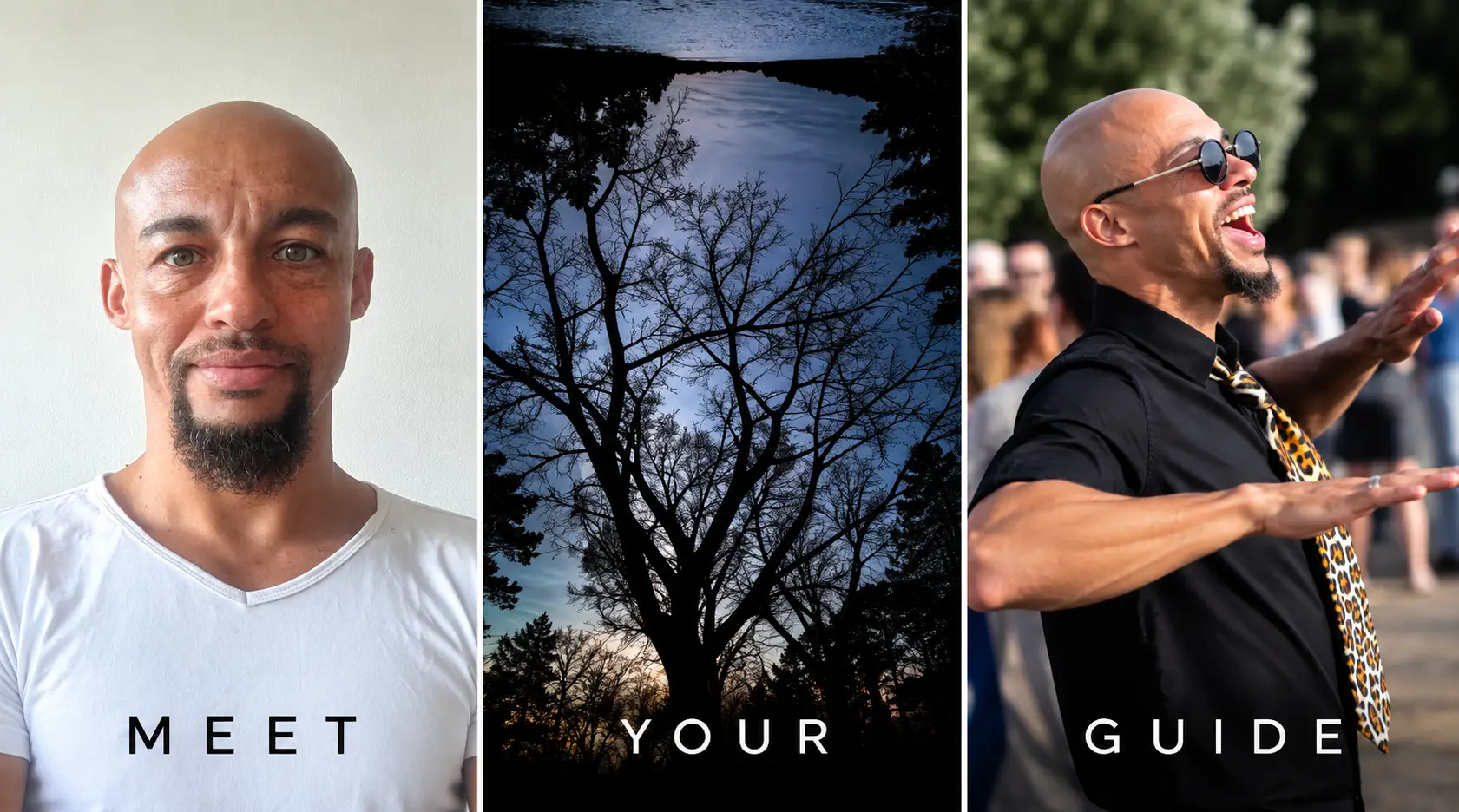
Meet your Guide Lynton a.k.a. The Dancing Poet
My story in short
I grew up with a restless, curious mind, trying to understand both the world around me and, especially, the darkness within myself.
When psychological help wasn’t always available, psychology became a way to explore my own anger, addiction and destructive patterns.
That search led me among others from psychology to philosophy and science (quantum physics) always looking for another perspective.
Life itself also became an education, through more than fifty different jobs (from projectmanager, to carbage man and from taxi driver to plantmanager for gas powerplant). Besides that addiction, depression, (toxic) relationships, different cultures and people from almost every layer of society, taught me much of what I know today.
Around the age of twenty-two, people began coming to me for a listening ear, perspective and guidance. For more than twenty years, I have spent thousands of hours walking alongside people through questions, struggles, desires and change.
Those years taught me that no single method, philosophy or perspective can explain the full complexity of a human being.
So rather than deciding who you are, I remain curious about everything that made you the person you have become.
Do you want to read more...?
My story is a story of extreme situations, endless curiosity, and both painful and beautiful lessons.
I grew up as the son of two people who, in very different ways, shaped the questions I would later ask about myself and the world.
My mother graduated from university with a degree in psychology. My father was an anti-apartheid activist with a brilliant yet complex mind.
When I was around three, I saw my father on television. I didn’t understand what he was fighting against, but seeing him stand for something larger than himself stayed with me.
I wanted to follow in his footsteps. By contributing, in my own way, to making the world a little fairer and a little more beautiful.
Around the age of six, my father suddenly disappeared from my life.
Afterwards came intense anger and suicidal thoughts that would remain with me, in different ways, for many years.
I was also growing up with an ADD mind that was constantly moving, connecting and questioning. At school, that often created problems. I struggled to fit the way my mind worked into the way I was expected to learn.
I was living inside a mind I didn’t understand.
When I discovered that my mother had studied psychology, my curiosity found somewhere to go.
I wanted to understand people.
But increasingly, I also wanted to understand myself.
At thirteen, I briefly had contact with my father again. Then came another twelve years of silence.
After that brief contact, my ways of escaping became increasingly destructive. By fifteen, I was using cannabis and hard drugs. Over the years, escape would take many forms, including food, alcohol, cigarettes, drugs, sex and gambling.
When the psychological help I sought was unavailable, delayed or didn’t fit the criteria, I kept looking for ways to understand what was happening.
Why was I so angry?
Why did I keep returning to things I knew were hurting me?
Psychology became more than an interest.
I began applying what I learned to myself.
One of the first techniques I worked with was NLP (Neuro-Linguistic Programming), which gave me practical ways to explore language, thought patterns and my relationship with my experiences.
From there, curiosity took me further.
Psychology led me towards philosophy and science.
Marcus Aurelius introduced me to Stoicism, while other traditions and philosophies, from Cynicism and Aristotelianism to Buddhism, Taoism and Existentialism, gave me different ways of looking at human behaviour, meaning, responsibility and freedom.
I wasn’t looking for one answer. I was collecting perspectives.
And throughout all of this, life kept providing its own education.
I started working at fifteen and have since had more than fifty different jobs, ranging from project management in major IT companies to working as a mechanic, taxi driver, garbage collector and sex worker.
I experienced addiction, depression, toxic relationships, sexuality, homelessness, different cultures and people from almost every layer of society.
Each gave me another perspective.
The world looks different depending on where you are standing.
Around the age of twenty-two, after emerging from what had been my deepest depression until then, something began to change.
People started coming to me.
At first, often simply for a listening ear.
Soon, some were seeking my support almost daily.
Alongside my full-time job, I regularly spent another ten to thirty hours a week listening to, questioning and supporting other people, without being paid and without thinking of it as a profession.
I simply wanted to understand what they were experiencing and explore with them what else might be possible.
And it continued.
For more than twenty years, thousands of people (friends, colleagues, acquaintances and complete strangers) have trusted me with their questions, struggles, desires and parts of themselves they sometimes found difficult to share elsewhere.
During those same years, I continued learning, questioning and changing my own perspectives.
Even my relationship with my father’s absence eventually changed.
I couldn’t change what happened.
But I could change my relationship with what happened.
And perhaps that captures something fundamental about what all those years have taught me.
I don’t guide people because I believe I have found all the answers.
Quite the opposite.
The more perspectives I encounter, the more aware I become of how many variables may contribute to what we see.
What began as a need to understand my own mind became a lifelong curiosity about the human being standing in front of me.
Not to decide who they are.
Not to fit them into a diagnosis, philosophy or method.
But to become curious about everything that might have contributed to who they are today.
____________________________________________
My Inner Compass
My inner compass is not a set of answers.
It is a collection of values, perspectives, philosophies and techniques that help me navigate how I relate to myself, to other people, and to the world around me.
A compass should help us navigate.
It should never prevent us from looking again.
When I guide someone, my compass does not tell them where to go.
It helps me remain aware of how I walk beside them while they discover their own.
..
Do you want to read more...?
My inner compass is a collection of values, perspectives, philosophies and techniques that help me navigate how I relate to myself, to other people, and to the world around me.
Some of those values may sound almost old-fashioned today.
Respect. Responsibility. Honesty. Curiosity. Caring for the body we live in and the nature we depend on. How we treat people when there is nothing to gain. How we treat ourselves when nobody is watching.
I am an idealist in that sense…
Not because I believe we should return to the past, but because I believe some of what we once considered valuable can still have meaning within the possibilities, freedoms and challenges of the world we live in today.
And because values, too, should remain open to examination.
Over the years, I have explored different philosophies, psychological perspectives and practical techniques, including NLP (Neuro-Linguistic Programming), Stoicism, Cynicism, Aristotelianism, Buddhism, Taoism and Existentialism, alongside insights from psychology and science.
I don’t follow any of them as a fixed doctrine. I take from each what proves useful, while remaining willing to question all of them.
A compass should help us navigate.
It should never prevent us from looking again.
Over the years, observing people, including myself, has repeatedly brought my attention to four areas of human life:
Addiction & Depression.
Communication & Perspective.
Sexuality & Identity.
Dance & Embodiment.
Not because these four areas contain all the answers.
But because I have found that each can reveal something about the relationship between our conscious intentions and the patterns operating underneath them.
What do we escape from and what are we longing for?
What do we say and what are we unable to say?
Who have we learned to be and what happens when identity begins to move?
How much freedom do we allow our bodies and what happens when we stop controlling every movement?
These are my focus areas.
They are not my compass.
They are places where I have learned to navigate with it.
And when I guide someone, my compass does not tell them where to go.
It helps me remain aware of how I walk beside them while they discover their own.
____________________________________________
____________________________________________
What Other People Experience
“Your words are inspiring, concise and clarifying.”
“No subject is avoided. Everything can be spoken about.”
“Your words make me reflect deeply on my own life, my values and my principles.”
“The way you can shift perspectives and bring positivity to them, you’re so good at that.”
“You are really inspiring and make me stop and reflect instead of simply continuing.”
____________________________________________
How I Guide
For more than twenty years, people have come to me with their stories, challenges and desires.
Sometimes with questions they could not yet put into words.
Some had already spent years receiving professional care.
Some came to me while experiencing suicidal thoughts or feeling they had nowhere left to turn.
Rather than judging someone or reducing them to a label, curiosity helped me keep seeing the person behind the challenge, the addiction or the struggle…
Do you want to read more...?
And when I listen to you, I don’t only listen to your words.
I observe.
The pauses between those words.
The change in your voice.
How you move.
How you breathe.
I notice non-verbal communication.
None of these observations gives me an answer on its own. They are simply variables.
The perspectives and techniques I have explored over the years help me look at those variables from different angles.
NLP made me more attentive to language and patterns.
Stoicism to the relationship between what happens and how we respond to it.
Buddhism and Taoism to presence, attachment and movement.
Psychology and science continually remind me to question what I think I know.
None of these perspectives tells me what is true for the person in front of me.
They simply give me more ways to remain curious.
Together, these observations become pieces of information that may help us explore how you arrived where you are today.
Because sometimes, the body seems to be telling a story the mind has not yet found the words to understand.
And within that space:
Nothing is too strange.
Not the thought you have never dared to say out loud.
Not the desire you fear someone might judge.
Not even the part of yourself you would rather hide.
I am not interested in deciding whether your experience is normal.
I am interested in understanding what it means to you.
That does not mean everything needs to be solved.
Sometimes recognition is enough.
Sometimes understanding why something exists changes our relationship with it.
And sometimes we are simply not ready to let something go.
But sometimes there comes a moment when staying where we are becomes heavier than the comfort of our comfort zone.
That is where I become curious about movement.
Not by forcing an answer.
Not by replacing your truth with mine.
But by looking together for the space in which another perspective might become possible.
Twenty years of conversations have taught me a great deal, including how much I still don’t know.
I still learn.
I still question.
I still discover my own blind spots.
I still change my mind.
I still get things wrong.
And I have learned not to be frightened when a truth I once believed no longer survives a new observation.
Sometimes that is precisely where another possibility begins.
What I bring into InnerGuide is therefore not a fixed route.
Not a promise to fix you.
Not an answer waiting for your question.
But experience.
Presence.
Observation.
Questions.
Curiosity.